
OpenAI just plugged into Epic. It still can't tell you whether the consult came back.
Read-only access to the record is the right call. It also shows where the record stops.
TL;DR
- On September 1, OpenAI connected ChatGPT for Healthcare to Epic. It's read-only. One of the four questions it supports: "What follow-ups, referrals, or unresolved issues should I be aware of?"
- A model reading a chart can surface a plan with no result. It cannot surface work that never entered the chart at all. That work has to be held somewhere else.
- More than 30 clinicians told us the same thing since April: the failure isn't a task marked done that wasn't. It's a task that was never done and never sent a signal.
- Every dropped item crossed a team or organization line. You can't fix that by getting the other side onto your tool. They can't be forced, most have no system of their own, and many don't control the channel.
The numbers behind this piece
- 30+
clinicians interviewed since April. None described a task falsely marked done.
Semblance clinician interviews, 2026
- 6.8–62%
of abnormal lab results had no documented follow-up.
Callen et al., J Gen Intern Med, 2012
- 1.0–35.7%
of abnormal imaging results had no documented follow-up.
Callen et al., J Gen Intern Med, 2012
- 40%
of asserted malpractice cases from 2014 to 2024 involved a communication failure, up from about 30%.
Candello, November 2025
On September 1, OpenAI announced that health systems can connect Epic to ChatGPT for Healthcare. UCSF and AdventHealth are named as pilot partners. The product line launched in January with Cedars-Sinai, HCA, Boston Children's, Memorial Sloan Kettering, and Baylor Scott & White. The connection is read-only. ChatGPT can read the authorized record. It cannot write anything back (PYMNTS, Unite.AI).
OpenAI lists four questions a clinician can now ask. The last one is this:
"What follow-ups, referrals, or unresolved issues should I be aware of?"
On September 2, Sergei Polevikov wrote that this "is not a technology breakthrough. It is a distribution event." He's right. We also think read-only was the correct call. Most of the damage a clinical AI product can do comes from writing. You earn the right to write by reading first.
But that fourth question is the one a chart reader can't fully answer. A model reading a chart can surface a plan with no result. It cannot surface work that never entered the chart at all. That work has to be held somewhere else.
Here's what the model can do. "MRI recommended last visit. No MRI report on file." That's a real gap, and catching it is useful. Here's what it can't. The consult that went to a contracted group that charts in its own system. The referral to a practice that got bought and stopped answering. The records request that went out by fax. None of those show up in Epic until something comes back. The problem is that nothing comes back.
And the model answers when asked. Nobody asks about the patient who isn't on today's schedule.
What did more than 30 clinicians say goes wrong?
Work that was never done, and never sent a signal. Not one clinician we interviewed described a task marked done that wasn't. Every story was the opposite. The order that sat in a queue. The consult nobody answered. The referral nobody scheduled.
Since April we've interviewed more than 30 clinicians. Hospitalists. Emergency physicians. Neurologists in clinic and on consult service. Family physicians. Nurses at the bedside, in clinic, and in management. They were paid research participants, so we quote them by role and setting, not by name.
They all told a version of the same story.
An emergency physician at a Level 1 trauma center: "A patient comes back from CAT scan, but it wasn't completed. Nobody told me why."
A neurologist who runs a solo referral clinic, on what happens to an imaging order after she signs it: "Maybe the order fell through... Maybe it never got sent out. Or maybe it did get sent out and they never contacted the patient."
A nurse manager at a children's hospital, on a task sent to two teams: "Both teams assumed the other was going to handle it."
A family physician in a two-doctor practice sent a sleep medicine referral. Then sent it again. The specialist's practice had just been acquired and went quiet for months. "They called him, like, six or so months later... we didn't even know if they'd been seen yet."
Every time, the clinician found out late or by accident. Every time, the system showed nothing wrong. Nothing had happened.
We expected to hear about tasks marked done that weren't. That's what people usually mean by a broken loop. Nobody described one. Not once.
We call this silent non-closure. The distinction matters. A task falsely marked done is a data problem. A task that never creates any state is a design problem. You can't fix it by making the checkbox more honest. There is no checkbox.
How often are abnormal results never followed up?
Often enough that this isn't a small-sample story.
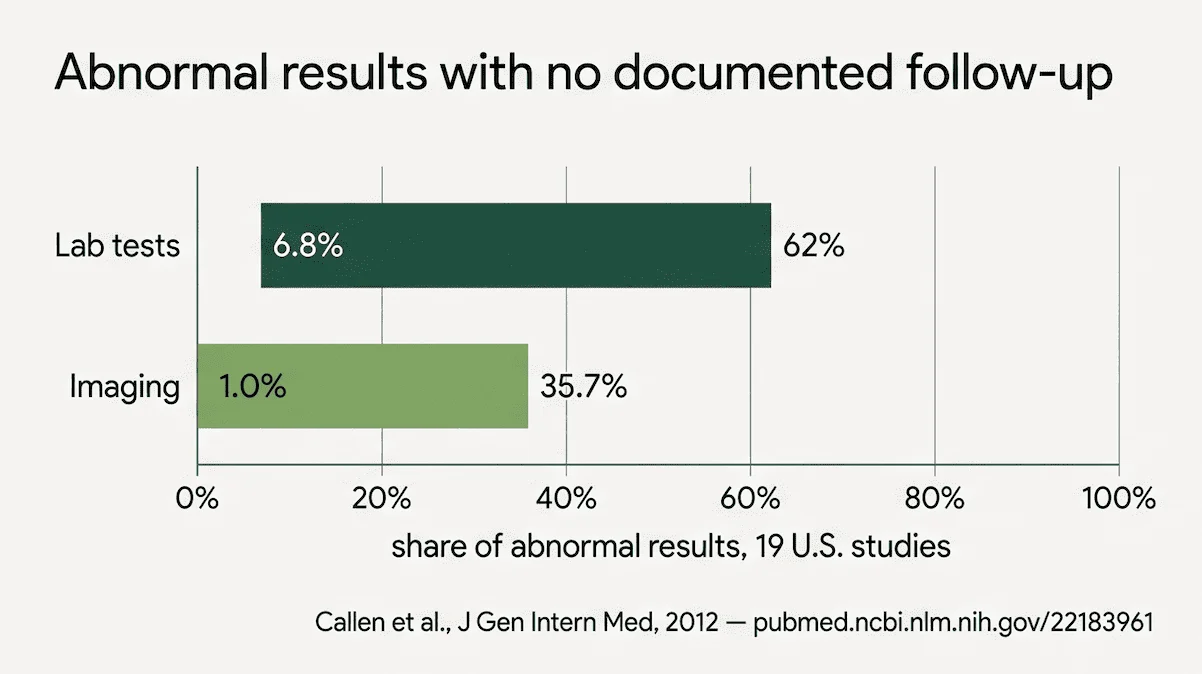
A systematic review in the Journal of General Internal Medicine pooled nineteen U.S. studies of test follow-up in outpatient care. The share of abnormal results with no documented follow-up ranged from 6.8% to 62% for lab tests and 1.0% to 35.7% for imaging. Missed cancer diagnoses were among the consequences (Callen et al., 2012). The authors noted "many individuals involved in the process" and "few guidelines regarding responsibility for patient notification and follow-up."
The malpractice data says the same thing. Candello's database covers about a third of U.S. medical liability claims. Its November 2025 report found communication failures in 40% of malpractice cases from 2014 to 2024. A decade earlier it was about 30%. Those cases had 39% higher odds of a payout. Provider-to-patient failures rose from 58% to 63% of the communication cases. 52% of breakdowns happened in outpatient settings, 41% inpatient (Candello 2025). Ten years of EHR adoption, and the number went up. That's what you'd expect if the failures live outside the EHR.
Does Epic track what you're waiting on from outside?
No. Epic tracks what Epic ordered. An order placed in Epic gets a signed, timestamped completion, and any CMIO will tell you that. What it doesn't track is what you asked a person to do, or what you're waiting on from a contracted group, an outside facility, or an insurer.
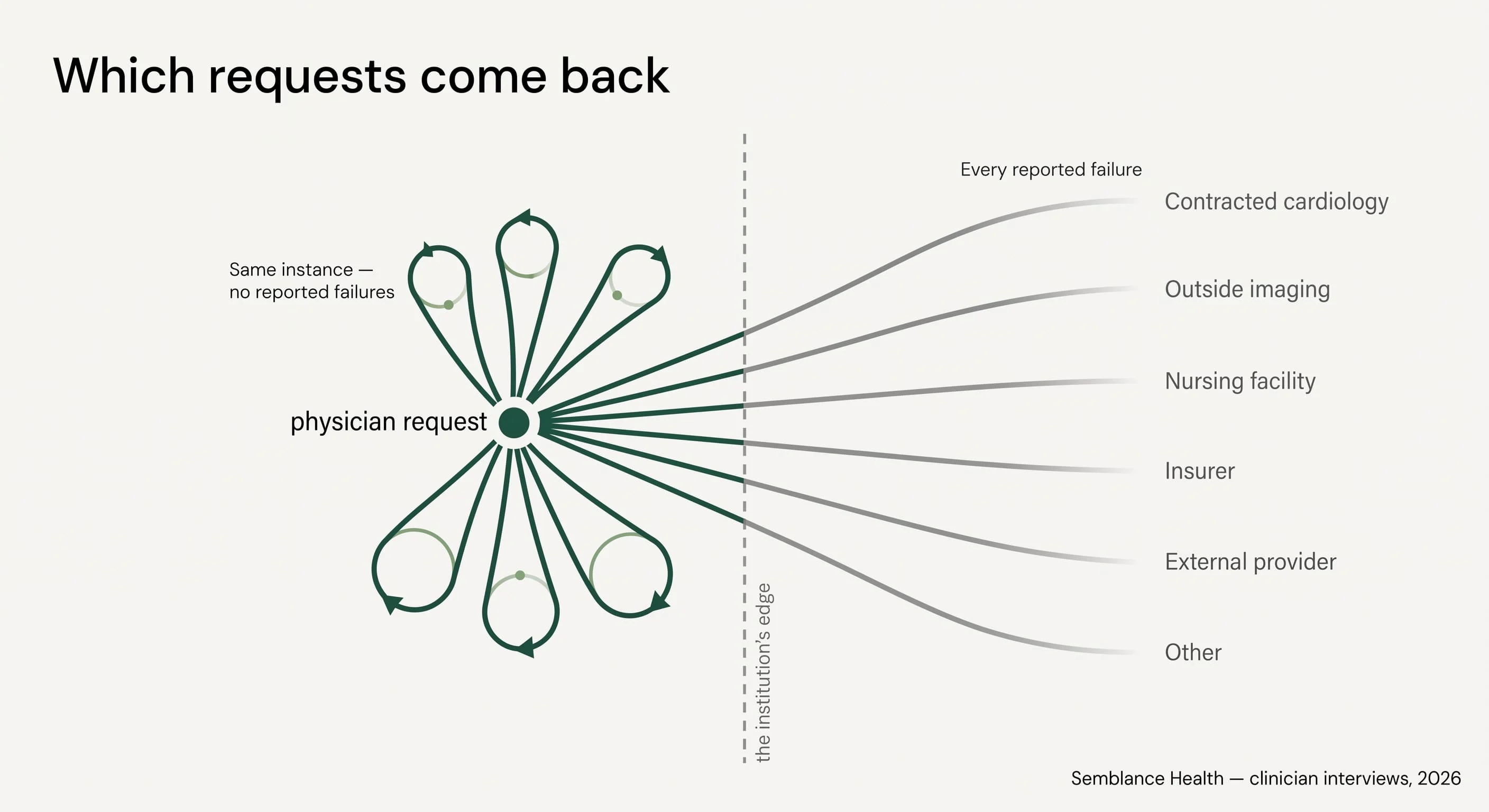
The pain didn't track the care setting. It didn't track specialty. It tracked one thing: how many people outside the physician's own team the plan depends on, times how many patients.
An internal medicine attending on a teaching service has fourteen patients. He estimated he spends about three hours a day delegating tasks and confirming they got done. Every consultant note becomes a new item to check, chart by chart. A neurologist in clinic put it at thirty minutes to an hour a day. The emergency physician, when we pushed her for a number, said about ten percent of her shift.
A bedside nurse told us the opposite. "Epic is really great with that... I need more manpower." She's right. Her tasks live inside one system, with people who share her task list.
Every dropped item in our interviews crossed a line. A team line: physician to consultant, day team to night team. Or an organization line: the practice to the imaging center, the hospital to the nursing facility, the clinic to the insurer. Not one failure happened inside a single system among people who share a task list.
The EHR isn't broken. It's bounded. Its edge is the edge of the institution's own instance. Clinical work stopped respecting that edge a long time ago.
Can you get the other side onto your tool?
No, and the interviews are why we stopped trying. The other side usually can't be forced. Most have no tracking system of their own. And many don't control the channel.
The instinct is to build a shared workspace and get everyone on it. We understand the instinct.
The other side usually can't be forced. A hospitalist described her hospital's contracted specialists: "They turned off their communication and you cannot get through to them." They're an independent business. Nobody in her hospital holds a contract that makes them answer a chat.
The other side usually has no system of its own. The family physician's practice tracks every outbound referral through one part-time medical assistant. "Tina... basically just has an Excel sheet that she goes through and will try and chase down people's referrals." That's not a lack of effort. That's the median. If your tracking system is a spreadsheet, theirs probably is too. Neither side can send a signal when something stalls.
And the other side often controls the channel. That same physician has read-only access to the local health system's Epic. She can see notes about her own patients. She can't respond to any of them. "I can't reply to anyone. I'm just like, hello."
Put that next to OpenAI's announcement. Read-only is the posture a big company chose because it's safe. It's the posture a small practice has because it's all they were given. Either way, the reader can see, can't act, and can't learn what nobody wrote down.
Polevikov says the survivors of this shift will have "deep workflow integration, highly specialized medical data, regulated write-back capabilities, and the willingness to own liability." We'd add one thing, and it comes before write-back: the willingness to hold a commitment open when no system on either side has recorded anything. That isn't a model feature. It's state somebody has to own.
So who holds the commitment?
Somebody on the physician's side, whether or not the other side ever answers. The unit that matters isn't the message. It's the thing the physician is waiting on. What it is. Who has it. How old it is. Whether it moved.
Three things follow.
First, verification has to work by observation, not participation. Read state wherever a path exists. The result that lands in an inbox. The note that shows up. The fax that arrives. Require nothing from the other side, because you won't get it.
Second, the list has to age in plain sight. Our cofounder, a practicing neurohospitalist, said it best: "It would be nice to know for each patient what we are waiting for." If that list exists and ages where someone can see it, a stalled dependency stops being silent. The wait becomes a number, not a hunch.
Third, reading the record is necessary and not enough. OpenAI reading Epic will make a lot of clinicians faster at understanding what happened. It will catch some plans that never produced a result. It won't see the ones that crossed an organization line. And it won't hold any of them. An answer at pre-visit review is not an owner, a due time, or an escalation. Somebody has to hold the question open until the answer arrives, or until the silence is old enough to be the answer.
One more thing, because it will come up. OpenAI reports physicians rated 99.1% of responses safe across 4,363 ratings in 27 use cases, including handoff summaries. That's a vendor-run evaluation, not a peer-reviewed study. Polevikov says so too. It also measures the wrong thing for this problem. A safe summary of an incomplete record is still a summary of an incomplete record.
We're building the layer that holds a physician's stated request open. One owner. A due time. Tracked across the people and places the EMR doesn't reach. We're selecting a small number of sites to reconstruct real cases with us before anything goes live.
If you run a hospitalist service, a specialty practice, or a case management team where the plan depends on someone outside your walls, give us twenty minutes. We'll walk through the last thing you had to chase, from the moment you asked to the moment you found out what happened. You keep the writeup either way.
No news is not good news. It's just no news.
What a chart reader sees, and what it misses
The cases from this piece, side by side. Read-only access catches the first one. The rest need someone to hold the request open.
MRI recommended last visit, no MRI report on file
Read-only chart reader
Can surface it. The plan is in the chart and the result is missing.
A held commitment
Has an owner and a due time from the moment it was asked.
Consult sent to a contracted group that charts in its own system
Read-only chart reader
Sees nothing until something comes back.
A held commitment
Stays open and ages until the note shows up.
Referral to a practice that was bought and stopped answering
Read-only chart reader
Has nothing in the chart to read.
A held commitment
The wait becomes a number, not a hunch.
Records request that went out by fax
Read-only chart reader
Invisible until the fax arrives.
A held commitment
Closes by observation when the fax arrives. The other side does nothing new.
Patient who isn't on today's schedule
Read-only chart reader
Answers when asked. Nobody asks.
A held commitment
Ages in plain sight whether or not anyone asks.
Owner, due time, and escalation
Read-only chart reader
None. The connection is read-only and creates no tasks.
A held commitment
One owner, a due time, and escalation when it stalls.
Run your own list through four questions
The unit that matters is the thing the physician is waiting on. Pick one patient and ask these about every open item.
“It would be nice to know for each patient what we are waiting for.”
What is it?
Name the thing you're waiting on. The consult note, the imaging report, the scheduled referral, the records.
Who has it?
One owner on your side, even when the work sits with a contracted group, an outside facility, or an insurer.
How old is it?
Count the time since you asked. If nobody can, the wait is still a hunch.
Did it move?
Look for evidence. A result in the inbox, a note in the chart, a fax that arrived. Silence that is old enough is the answer.
Questions this piece answers
- What can ChatGPT for Healthcare do with Epic records, and what can't it do?
- As of September 1, 2026, it reads a patient's authorized Epic record and answers questions about it. What changed since the last visit. Which labs to review. Documented follow-ups and unresolved issues. It's read-only. It doesn't write to the chart, place orders, or create tasks. It can't see work that went to another organization and never produced a chart entry. And it answers when asked, rather than tracking anything over time.
- How often are abnormal results never followed up?
- A systematic review of nineteen U.S. outpatient studies (Callen et al., J Gen Intern Med, 2012) found 6.8% to 62% of abnormal lab results and 1.0% to 35.7% of abnormal imaging results had no documented follow-up. Missed cancer diagnoses were among the consequences.
- What is silent non-closure?
- A clinical task or dependency that is never completed and sends no signal that it stalled. The order that sat in a queue. The consult nobody answered. It's different from false closure, where a task is marked done but wasn't. Every dropped item in our interviews was the first kind.
- Does Epic track what you're waiting on from outside?
- No. Epic tracks what Epic ordered. An order placed in Epic gets a signed, timestamped completion, and any CMIO will tell you that. What it doesn't track is what you asked a person to do, or what you're waiting on from a contracted group, an outside facility, or an insurer.
- Can you get the other side onto your tool?
- No, and the interviews are why we stopped trying. The other side usually can't be forced. Most have no tracking system of their own. And many don't control the channel.
About the author

Co-founder & CEO, Semblance
Led $100M+ Data & AI partnerships at IBM and GitLab, spanning enterprise AI platforms, strategic alliances, and commercialization. Published trustworthy-AI and high-performance computing researcher.
Sources
- Healthcare organizations can now connect EHR and additional industry data to ChatGPT
OpenAI, September 1, 2026
- OpenAI Brings Epic Health Records to ChatGPT for Clinicians
PYMNTS
- OpenAI Connects Epic Health Records and Public Data to ChatGPT
Unite.AI
- ChatGPT Health + Epic Integration Just Killed the Healthtech AI Industry
Sergei Polevikov, September 2, 2026
- Failure to Follow-Up Test Results for Ambulatory Patients: A Systematic Review
Callen et al., J Gen Intern Med, 2012
- New Candello Report Reveals Communication Failures Between Providers and Patients are Rising
CRICO / Candello, November 17, 2025
Interviews with more than 30 clinicians, quoted by role and setting
Semblance, 2026
Walk us through your last chase
Twenty minutes, from the moment you asked to the moment you found out what happened. You keep the writeup either way.