Silent non-closure is clinical work that was requested but never confirmed done, and that sends no signal when it stalls. It's the order that sat in a queue, the consult nobody answered, the referral nobody scheduled. We built a verification layer for clinical work because the gap between ordering and confirming completion is where patients get hurt.
The short version
Silent non-closure is a request that never gets done and never creates a signal. It differs from false closure, where a task is marked done but wasn't.
It happens at the boundary, the moment a request leaves one person's ownership and enters another's.
“Ordered” and “completed” are different states. A system that tracks orders but not completions can't see the gap.
Closing it takes four facts per patient: what is pending, who has it, how old it is, and whether it moved.
What is silent non-closure?
Silent non-closure is when clinical work is requested but never confirmed done. It falls through the gap between systems, handoffs, or people.
The word that matters is silent. Since April, we've interviewed more than 30 clinicians: hospitalists, emergency physicians, neurologists, family physicians and nurses. We expected to hear about tasks marked done that weren't. Not one clinician described that. Every story was the opposite: work that was never done and never sent a signal.
“A patient comes back from CAT scan, but it wasn't completed. Nobody told me why.”
Emergency physician, Level 1 trauma center
That distinction changes the fix. A task falsely marked done is a data problem. A task that never creates any state is a design problem. You can't make the checkbox more honest when there is no checkbox.
Why is “ordered” not the same as “completed”?
Ordered versus completed is the distinction between “I asked for it” and “it is done.” A system that tracks orders but not completions is the root of the silent non-closure problem.
The EHR does its own job well. An order placed in Epic gets a signed, timestamped completion. But Epic tracks what Epic ordered. It doesn't track what you asked a person to do, or what you're waiting on from a contracted group, an outside facility, or an insurer.
The inbox has a quieter gap. Clicking a message marks it read whether or not anything was done, so a message that was opened and never handled looks finished.
So physicians hold the list themselves. When we asked clinicians how they track what they're waiting on, not one physician named the EHR. An internal medicine attending on a teaching service told us, “I do it by paper and pen.”
Where does the work get lost?
At the boundary. The boundary is the moment a request leaves one person's ownership and enters another's. It's the point where work is most likely to be lost.
Every dropped item in our interviews crossed one. A team line, such as physician to consultant or day team to night team. Or an organization line, such as the practice to the imaging center or the clinic to the insurer. Not one failure happened inside a single system among people who share a task list.
“Both teams assumed the other was going to handle it.”
Nurse manager, children's hospital
A family physician in a two-doctor practice sent a sleep medicine referral, then sent it again. The specialist's practice had just been acquired and went quiet for months. “They called him, like, six or so months later... we didn't even know if they'd been seen yet.”
How often does it happen?
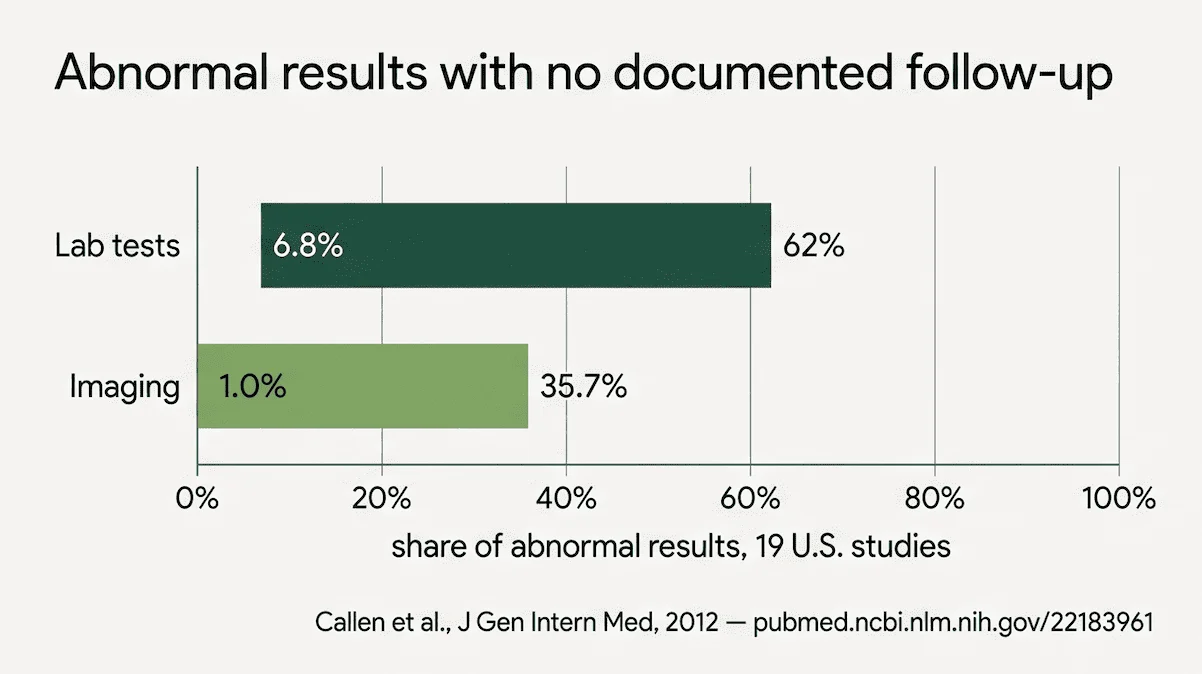
Often enough that it isn't a small-sample story. A systematic review of nineteen U.S. outpatient studies found that 6.8% to 62% of abnormal lab results and 1.0% to 35.7% of abnormal imaging results had no documented follow-up. Missed cancer diagnoses were among the consequences (Callen et al., J Gen Intern Med, 2012).
Share of abnormal results with no documented follow-up across 19 U.S. studies. Source: Callen et al., J Gen Intern Med, 2012. View the study
Malpractice data points the same way. Candello's database covers about a third of U.S. medical liability claims. Its November 2025 report found communication failures in 40% of malpractice cases from 2014 to 2024, up from about 30% a decade earlier (Candello, 2025).
It costs time, too. An internal medicine attending with fourteen patients estimated he spends about three hours a day delegating tasks and confirming they got done.
What does it take to close the gap?
Our cofounder, a practicing neurologist, put it in one line: “It would be nice to know for each patient what we are waiting for.” Taken as a spec, that means four facts per patient.
What is pending
Stated by the physician in their own words when they ask, rather than pulled from a note later.
Who has it
A person or a named outside party rather than a department, and whether they've accepted it.
How old it is
Paper can't show this. A consult request six hours old and one three days old look the same on a sheet.
Whether it moved
A result landed, a note appeared, or a call came back. If nothing did, the silence is old enough to mean something.
None of these needs the other side to join a new tool. An insurer won't, a contracted group won't, and a practice that just changed owners can't. So verification has to work by observation, not participation. Watch for the signal wherever one already exists: a result lands, a note appears, a call comes back, a decision posts.
How Semblance keeps a request open until it's closed
Semblance turns a clinician's stated request into one accepted, accountable commitment, with an explicit owner, due time, escalation, and evidence of closure. State a request once and confirm it. Semblance gets it accepted by the right owner, tracks status and blockers, and escalates by your team's rules.
It works alongside the systems you already use, reading orders, results, and schedules through SMART on FHIR. Every commitment exports as a FHIR Task, Provenance, and AuditEvent, so closure is anchored to your EHR's own record. No rip and replace.
Example commitmentVerified closed
Stated requestCoordinate Garcia's discharge with care team
Confirmed commitmentPatient, action and urgency confirmed before it routes
Accepted ownerOne accepted owner, due today 2:00 PM
Status & escalationBlockers tracked, escalated by your team's rules
Verified closedClosed with evidence: callback documented
Questions this piece answers
What is silent non-closure?
A clinical task or dependency that is never completed and sends no signal that it stalled. The order that sat in a queue. The consult nobody answered. It's different from false closure, where a task is marked done but wasn't.
What is the boundary in a clinical handoff?
The moment a request leaves one person's ownership and enters another's. It can be a team line, like physician to consultant, or an organization line, like clinic to insurer. It's where work is most likely to be lost.
Doesn't the EHR already track this?
It tracks its own orders. An order placed in Epic gets a signed, timestamped completion. It doesn't track what you asked a person to do, or what you're waiting on from outside the institution.
How does Semblance verify closure?
Each commitment carries one accepted owner, a due time, and live status, with accept, decline, and delegate built in. It closes with evidence and exports as a FHIR Task, Provenance, and AuditEvent.